A Fintastic Summer on the West Coast of Scotland
A Fintastic Summer on the West Coast of Scotland ~ Megan Hamill ~ Ocean Citizens Award Recipient
I look out to sea with the Isle of Mull coming closer into view. It’s hard to believe that I will be living there for the next 5 months. Most of my possessions are packed into my car, the last one squeezed onto the ferry, to move to Tobermory and begin a volunteer placement with the Hebridean Whale and Dolphin Trust. As we move further from the mainland a hopeful feeling washes over me, and I feel ready for the opportunity that lies ahead.
This all would have felt impossible to me a few years ago, where struggles with my mental and physical health made it hard to even get out of the house. During this time, I turned to the sea for solace. Growing up on the Isle of Arran the sea was never far but I, like many who grow up by the sea, was guilty of not truly appreciating it. When my ability to do things was reduced I gained a new appreciation for the small things. A walk on the beach, a swim in the sea, or a snorkel under the waves, became the things that kept me going.
It was around this time I first got involved with marine conservation, completing the Turning the Tide Programme with Young Sea Changers Scotland and volunteering locally with the Community of Arran Seabed Trust (COAST). Through these experiences I was able to build up my confidence and when I saw an opportunity to volunteer with the Hebridean Whale and Dolphin Trust (HWDT) I felt ready to test myself and learn something new.
After hearing the great news that I had got a spot on the volunteer placement on Mull, I looked into funding to help make the most of this opportunity. I heard through Young Sea Changers Scotland about Seaful’s Ocean Citizen Science Award. I was familiar with Seaful through their work with COAST, and was inspired by their goal to connect more people to the sea. Receiving the award made the idea of moving to Mull and volunteering in whale and dolphin conservation a reality.
Minkie!
My first month on Mull was a dream. I had just finished the last of my university assignments and was able to spend as much time as possible outside in the spring sunshine. I met fellow volunteers at the Hebridean Whale Centre where we learned all we could about whales, dolphins and porpoises. We put all of this learning into practice on our first guided walks and land-based watches. It wasn’t long until I saw my first minke whale.
On a sunny, wind-free morning we headed out to the Glengorm Estate just outside of Tobermory. As we reached the headland, the bright blue of the Sound of Mull stretched out in all directions, with views across to Ardnamurchan and beyond, to the Small Isles. There was hardly a breath of wind. The water lay flat and still. We arrived at our watching spot and set up the scope and binoculars. With the other guide’s keen eyes on the water, I turned to the group and began describing some of the marine species of the Hebrides. Then a shout: “Minke!” I whizzed my head around to look where fingers had pointed and watched as a dark back and sickle-shaped fin rose slowly and descended again into the depths. Over the next half an hour we were treated to the amazing spectacle of breaching minke whales. We watched as they lunged out of the water, mouths agape to be filled with fish. For a small whale they can make a big splash! Watching these extraordinary animals through my binoculars was nothing short of magical, and from that moment I was hooked.
Sailing Out
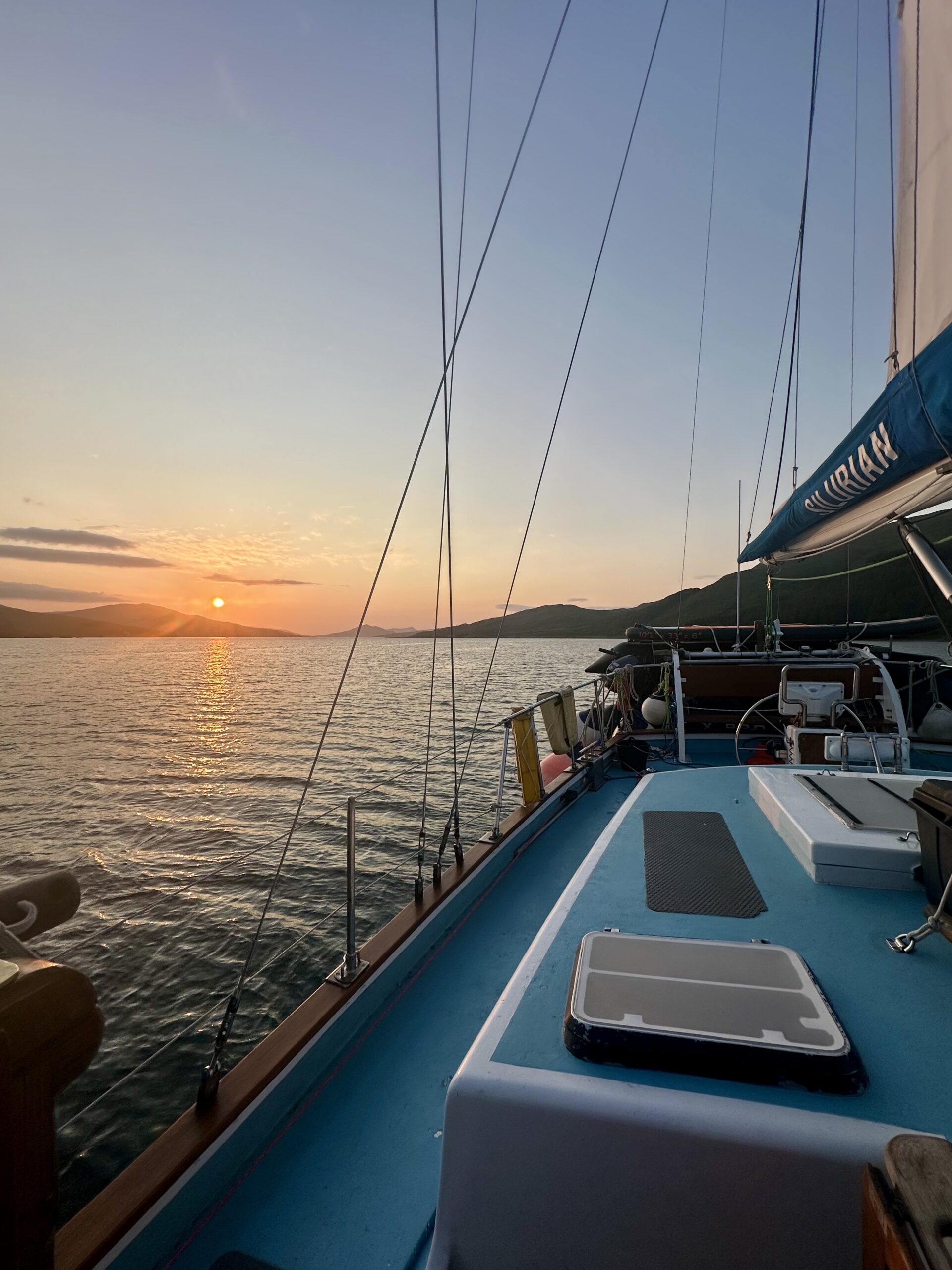
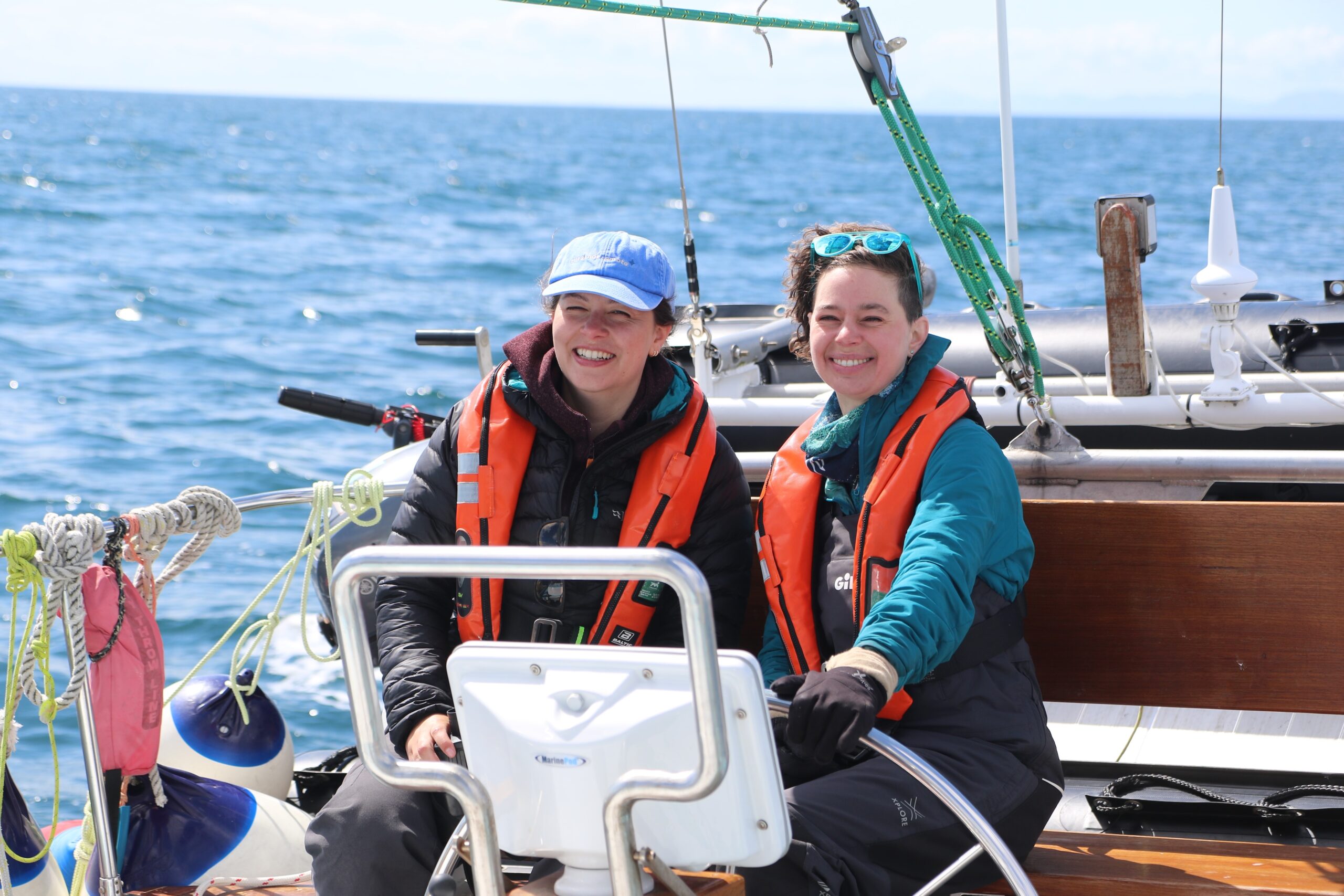
After a month on Mull, I was due to head out on Silurian, HWDT’s research vessel that sails along the west coast monitoring and collecting data on whales, dolphins and porpoises. I would love to say that I was completely ready for the adventure but the truth was I was incredibly nervous. I had spent some time on boats in the Clyde but never for several days at a time or on rougher unpredictable seas. As I walked down to the pontoons I had a feeling that I would not be the same after this trip. The mixture of excitement and anxiety made my stomach turn. This feeling continued when we left the bay and as soon as we sailed out into Sound of Mull my head was in a bucket! I had serious doubts about what I had signed up for but I could not have wished for better crewmates. I soon started to feel excited for what was ahead.
The next couple of days in Mallaig were spent getting Silurian ready for the trip and soon we set off, sailing north towards Skye. It took a couple of days to get into the routine of boat life and I surprised myself with how much I loved it. Silurian was used during filming of the first Blue Planet series, and on board I felt as if I had stepped into the David Attenborough documentaries I had grown up watching.
My first month on Mull was a dream. I had just finished the last of my university assignments and was able to spend as much time as possible outside in the spring sunshine. I met fellow volunteers at the Hebridean Whale Centre where we learned all we could about whales, dolphins and porpoises. We put all of this learning into practice on our first guided walks and land-based watches. It wasn’t long until I saw my first minke whale.
On a sunny, wind-free morning we headed out to the Glengorm Estate just outside of Tobermory. As we reached the headland, the bright blue of the Sound of Mull stretched out in all directions, with views across to Ardnamurchan and beyond, to the Small Isles. There was hardly a breath of wind. The water lay flat and still. We arrived at our watching spot and set up the scope and binoculars. With the other guide’s keen eyes on the water, I turned to the group and began describing some of the marine species of the Hebrides. Then a shout: “Minke!” I whizzed my head around to look where fingers had pointed and watched as a dark back and sickle-shaped fin rose slowly and descended again into the depths. Over the next half an hour we were treated to the amazing spectacle of breaching minke whales. We watched as they lunged out of the water, mouths agape to be filled with fish. For a small whale they can make a big splash! Watching these extraordinary animals through my binoculars was nothing short of magical, and from that moment I was hooked.
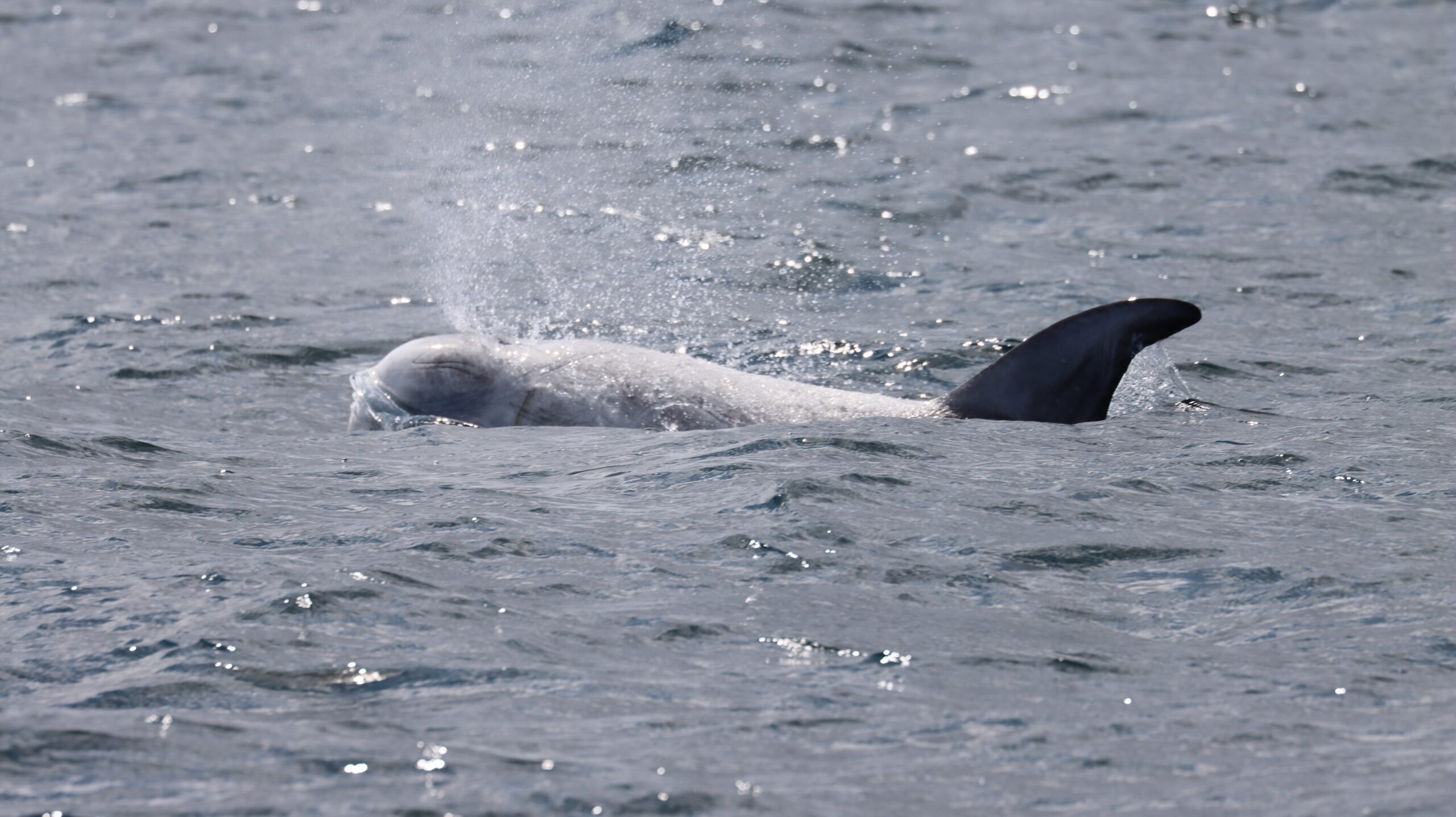
As we headed further north towards the Hebrides, I could sense an air of anticipation. We were approaching Tiumpan Head when someone shouted “sighting!” I glanced to my left to see a white dorsal fin glinting amongst the waves. Rissos! Science officer Hannah sprang into action and thrust a camera in my direction to get ID shots. The aim was to get clear shots of the dorsal fins in order to identify the individuals. The engines were turned off and we watched as this magnificent pod swam right past the bow. But one of the dolphins did not look like the others, and taking a closer look it turned out we had another species – white-beaked dolphins. Two of the rarest dolphins in Scotland in the same place! I would be lying if I said I didn’t shed a tear. We didn’t have long to process the amazing experience as the sightings just kept coming in, minke after minke and more white-beaked dolphins including a tiny baby. The day ended with a swim in the bay in the beautiful blue waters of the Hebrides with fulmars flying above.
The next day we sailed up to Butt of Lewis, the most northerly point of the Outer Hebrides, and then began to sail east to cross the Minch. I had heard of the infamous rough seas of the Minch but we were incredibly lucky, the wind was low and the overcast weather made for perfect sighting conditions. We were around half way across, when someone said they had seen a blow. This was very exciting as only the larger species of whales in Scotland produce large blows that can be seen from a distance. As we approached we realised we were seeing two separate blows, followed by large splashes, and then some very large pectoral fins. This was a feeding frenzy of two fin whales! The second largest whale on the planet and here I was seeing it with my own eyes. Again the cameras were out to capture the all-important ID shots but these whales were incredibly fast. As soon as the boat caught up, they would surface further away. Soon the feeding was over, and I was left lost for words at the incredibly rare encounter we had just had.
Community
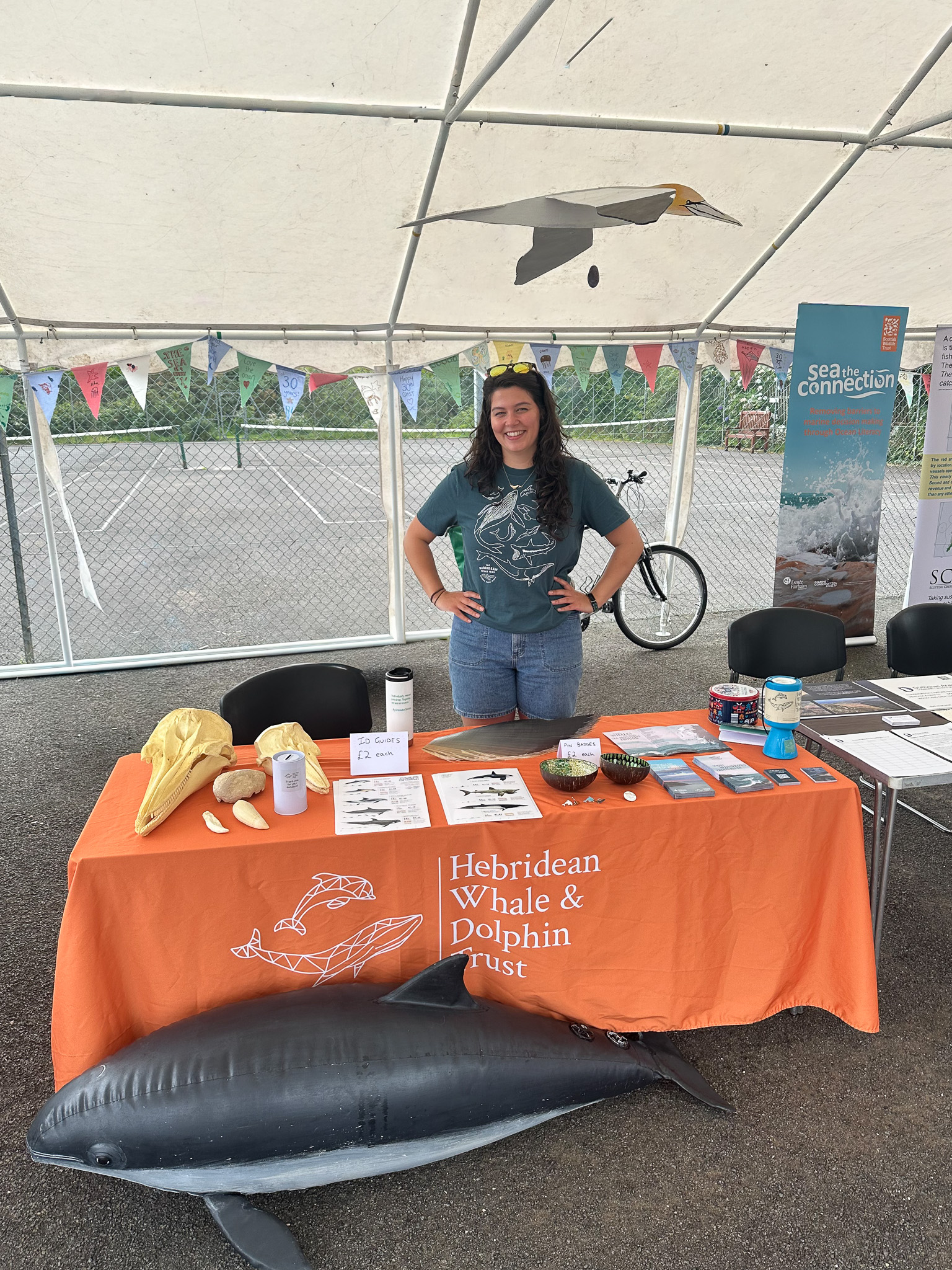
Back on land after the trip of a lifetime, I got back into the routine of guided walks and engaging visitors at the Hebridean Whale Centre. During this time I thought about how I could take my learning and experiences further and give back. I completed a grant writing course, learning how to effectively fundraise for conservation projects. I also continued to volunteer for COAST and, through the support of the award, was able to travel back to Arran for the charity’s 30th birthday celebration where I ran an information stall on HWDT’s work. It was great to share what I had learned with my community, and speak to people about some of the amazing historical sightings on Arran. The 30th birthday celebration was a great success and there was a real feeling of pride amongst the community for what COAST has achieved.
Inspired by the amazing encounters, I decided to take my learning about marine mammals further by training to become a BDLMR Marine Mammal Medic. During the training I learned how to successfully refloat stranded animals and keep the public and myself safe during the process. This gave me reassurance that if we ever had an incident with an injured marine mammal on Arran that I would be equipped to help.
Beneath the Tides
I was incredibly lucky with wildlife encounters this year but the main drive for my passion for the ocean came from those small moments. The truth is if I hadn’t been forced to slow down, look and notice, I would not have formed the connection to the sea that led to these incredible experiences. Most of us live unaware of the spectacle of the underwater world that exists alongside us. This is why it was incredibly important for me to train as a snorkel instructor. Next year I hope to help COAST deliver Snorkel Taster Sessions and open up the beauty of the marine environment to others.
After completing my placement with HWDT in September, I returned to Arran. It wasn’t long till I found myself back under the water, snorkelling in the No Take Zone in Lamlash Bay. I plunged my face into the biting cold into an underwater world teeming with life. Hundreds of juvenile fish snaking in and out of the kelp, crabs scuttling across rocks with starfish the size of dinner plates, and beautiful snake lock anemones dancing in the current. It only takes a few minutes beneath the waves to realise that this place is special.
The No Take Zone is the only marine protected area of its kind in Scotland, banning all forms of fishing and extraction. Since 2008, this strict protection has led to a dramatic recovery of the seabed. This is all thanks to the amazing effort of COAST and the local community on Arran to protect their local waters. The work of COAST makes me incredibly proud of where I come from, so I was honoured when I was asked to join the board of trustees this year. The organisation has done so much for the community but has also set a precedent for marine protection in the UK. When protected, our seas can recover, and this is the ultimate hope for the future.
The Next Wave
My connection to the sea has offered me opportunities I could not have ever imagined. I feel more inspired than ever in my journey as a marine advocate and I am determined to continue to speak up for the ocean.
I’m incredibly grateful to Seaful and to Felix Appelbe, for the opportunities made available to me through the Ocean Citizens Award. I have experienced and learned so much this year, but by far the best thing about this award was being equipped with the ability to create memorable ocean experiences for other people.
If we are to tackle the challenges facing our seas we must inspire as many people as possible to become marine advocates and stand up for the ocean. To care about the marine environment we have to be able to connect to it on some level. So I encourage everyone, next time you are by the coast, to pay attention and take notice of the things around you. In the process, you might find you leave feeling a little lighter, with your worries taken away by the tide.
Written by Megan Hamill ~ Ocean Citizens Award Recipient