My Experience With Sea Turtles in Karpas
My Experience With Sea Turtles in Karpas ~ Arwen Horsburgh ~ Ocean Citizens Award Recipient
I was first sent the link to the Sea Turtle Research and Conservation Project in Cyprus back in February of this year, through my involvement in the Ullapool Sea Savers.
The Ullapool Sea Savers are a youth-led marine conservation charity located in the north west of Scotland who are committed to helping protect and conserve our oceans. I first joined the Sea Savers in 2019 due to my passion for marine conservation and personal connection to the oceans.
Little did I know then that this would lead to me becoming the Sea Turtle Ambassador and going on this.
Before I get to the turtles though, I’d like to share why the ocean and the creatures that live in it are so important to me.
Growing up I was immersed in the sea both physically and mentally as it was only two meters from my bedroom window. The dampened sound of crashing waves rocked me to sleep for 17 years. From sailing to swimming and snorkeling I was lured into its ample fortress of creatures, spending many hours of my early childhood on the beach below my house scouring the underside of rocks for crabs and anemones. With each rock I overturned, I learnt more about the secret lives within my little kingdom.
The sea was an enduring entity in my life; a reliable constant that promised always to be there. This is why, after realising the plight of marine life around the world, I felt compelled to try and protect it.
I had always wanted to work abroad and volunteer in the marine field, so when the opportunity to travel to Cyprus came up, I jumped at the chance. Once I was accepted into the Sea Turtle Project, I quickly set about trying to find funding.
I was introduced to the Ocean Citizen Award by Seaful’s founder, Cal Major, and it was the perfect opportunity to not only get financial aid but also mentoring and a support network to help me get the most out of this trip to further propel my advocacy for the oceans. Receiving the award opened a door into the incredible network of people within the Seaful charity and I am remarkably grateful to the team for being so welcoming, supportive and kind throughout this journey and beyond.
With all this support, it was time for me to meet the turtles.
Outbound
As my father and I sat on the floor of Edinburgh airport at about 3:30am looking up at the big screens full of flight details, a combination of excitement and nerves began to settle into my stomach. This was my first time flying in seven years and my first time flying alone, so understandably I was a tad anxious. But this anxiety was more to do with getting myself on connecting flights than actually flying. The flight from Edinburgh to Heathrow was roughly an hour. As we landed, self-doubt trickled through my mind.
Could I do this? When I saw the gate for my connecting flight to Larnaca was the first one through the arrivals door, my self-doubt began to drain away. As the plane took off for Larnaca, I was in a better headspace.
After landing in Larnaca I met with 3 other girls who were going to be volunteering with me. We shared a taxi from the south side of Cyprus through the border and into the north side to our one night stop over in Taşkent at the Wildlife Rescue and Rehabilitation Centre before our drive to Cyprus Marinelife Centre on the Karpaz Peninsula the following day.
I hadn’t quite realised how grounding being able to see the ocean was for me until I landed in Cyprus. As the heat intensified, I started to feel quite claustrophobic in Taşkent, even though the sea was only behind some hills.
It wasn’t until the next day as we drove to Karpaz that I felt a huge sense of relief when the turquoise blue cut into view. It was in that moment I came to fully understand the depth of how important the sea is to me.
Karpaz
My time with the project spanned the two week bridge from July to August during which nesting season was beginning to drop off and hatching season was starting to pick up. The volunteers and team leaders met at 4:30am and split into their assigned groups. At 5am on the dot, the three groups would bustle off in different directions and vehicles, with the fleeting remnants of sleep clinging to our tired eyes. Once on the beaches, we were assigned to either nesting or non-nesting tasks. Nesting tasks included identifying nests, finding the eggs, taking measurements and recording the nest ID, while non-nesting tasks involved counting and then squeegeeing the turtle tracks made from the night before to stop the next day’s group counting the same tracks twice.
Locating the egg chamber was a complex task, as the turtles dig a body pit, then an egg chamber. Once they have laid their eggs, they completely cover them with sand. This means there is a large scattered area in which the egg chamber could be. The experience of finding my own nest for the first time was marvelous.
When I felt the drop in the sand with the poking stick a surge of excitement raced through me and I began to dig.
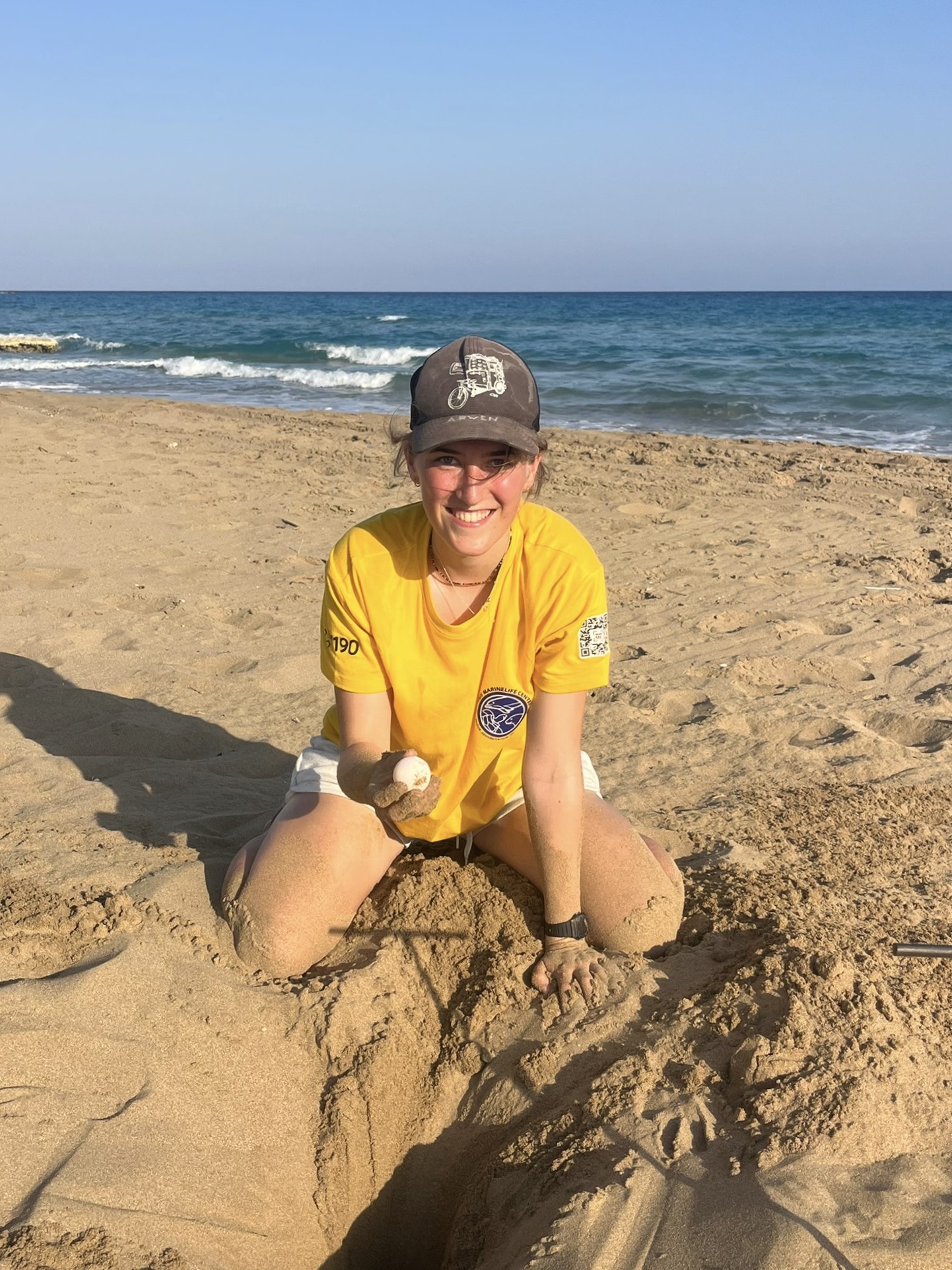
Digging in that top layer of dry sand is a tiring job. Just as you think you’re making progress, the hole refills itself, but slowly I made headway. I could feel the difference in sand as I dug – the sand from the egg chamber was soft and moist whereas the surrounding sand was tougher and harder to remove. My hand then touched something round and solid, I had reached the eggs. Slowly and carefully, I drew my hand out of the pit. Clasped in my palm was a bright white and perfectly spherical ball, similar to a pingpong ball.
As I began writing down the measurements from eggs to surface and distance to the sea, a euphoric pride whirled in my stomach along with a sense of incredulity, it almost didn’t feel real, I had dreamt of this from such a young age.
As we walked across the unstable sand a whisper would occasionally dance through the group, a mother was nesting up ahead.
Now, for the volunteers who had been there for a month or so, this wasn’t as exciting as it was for the newcomers. The first time I heard this, I was ecstatic, my eyes transfixed on the dark shelled body just peaking out from the surrounding sand. She was slow yet strikingly strong, her front flippers spraying the heavy sand metres into the air. Keeping our distance, we admired her huge shell and her wise eyes. As I watched I became overcome with an indescribable feeling of awe, she held this presence of enduring immortality, wisdom and patience. This made sense coming from a species that is over 100 million years old.
From about the fourth day into my trip we started to do excavations, which meant digging up nests that were over due the 70 day mark for hatching to take note of the number of hatched and unhatched eggs, what stage they are at (1, 2 or 3) and also to find live hatchlings that haven’t made their way to the water naturally. To find the specific nests that needed excavating we had to search the nest signs for the correlating nest ID and then begin digging.
Excavating nests could either be incredible or slightly heartbreaking depending on the outcome. There were usually a fair amount of unhatched eggs at the bottom of an egg chamber which we had to open to assess how far developed the eggs were. But for me, the highlight of the trip was excavating a nest full of babies.
The feeling of digging your hand into the sand and your fingers meeting intense wriggling and grippy flippers beating their way to the surface was incredible. Their robust little bodies were battling one another for purchase, utter instinct and determination coursing through their miniature veins.
My face would always ache after a hatchling-rich excavation as my mouth was set in a permanent grin, from either pulling out hatchlings or being handed writhing handfuls of them.
After the excavation was complete and the numbers counted, we would release the eager buckets of babies.
Off they would go, scurrying across the sand towards the sea. Their innate sense of direction was astounding, although of course there were a couple of little guys that needed some extra assurance on their way to the water. Once they reached the water line they would face their first big obstacle: their first few waves. The surf would push them back up the beach, but without fail they beat their tiny flippers and off they went. Then their heads would appear at the surface past the break to take in air.
I watched through an almost maternal gaze as these little black dots created drifting constellations in the turquoise abyss.
Another cause for dismay came from predation. Dogs, foxes and crabs would dig their way to the eggs and have their fill of the developing babies below, leaving eggshells littered around the nest. We would count the predated egg shells, bury them at the back of the beach and then re-cover the remaining eggs with sand.
Plastic
Coming from a small town in the north west of Scotland that is relatively sheltered from plastic pollution, I was not prepared for the level of plastic I saw here. It created a blanket across the beaches in northern Cyprus.
Not only were there larger pieces of waste, such as old washing machines and pipes, but also minute beads of plastic that stretched as far as the eye could see.
It was truly appalling and it felt hopeless trying to clean up as it would take an entire day to cover even a third of the beach, before you even considered the microplastics.
To make matters worse, this didn’t stop and start on the sand itself. A layer of microplastics lay at the water’s surface, so we were often snorkelling through a graveyard of old crisp wrappers and cellophane. It’s no wonder that plastic is the leading cause of death in sea turtles when there’s more plastic than food in the ocean.
Departing
I felt as though the 2 weeks had flown by far too quickly and I was very sorry to leave, not only would I miss the work and getting to hold the tiny hatchlings but also the people.
As me and 4 other volunteers left in the same taxi we had arrived in, I ran through the different memories I had created in my time there, from free diving into underwater caves on our last beach day and playing intense card games before bed, to learning people’s different backgrounds and cultures, reading in the hammocks at camp and even taking cold showers on hotter days. I knew this was an experience I would long to have again.
I have gained an amazing amount from this experience, including developing more confidence in myself and my capabilities and obtaining a very personal appreciation for these creatures that I will continue to love and advocate for.
This trip also broadened my cultural knowledge about the heavy divide in Cyprus between the north side of the island, which is Turkish Cypriot, and the south side, which is Greek Cypriot, and the political issues between the two.
The Future and a Thank You!
I would urge anyone interested in marine conservation or conservation of any kind to check out volunteer opportunities and get involved in any which way they can. It is such an incredible and rewarding experience that will only enhance your love for the natural world and further help to preserve it.
I would also like to again thank the Seaful charity and Felix Appelbe, the founder of the Ocean Citizen Award, for choosing me as a recipient. The experience this award has enabled me to have will stay with me forever and has equipped me enormously for a future linked to the protection of our seas, whether through more volunteering or writing.
I hope to inspire more children not only from the Sea Savers (where this all began) but also others from remote areas to help them realise they are bound by nothing and can experience something like this too.
Arwen Horsburgh ~ Seaful Ocean Citizen